
Seaweed farm can produce as much sustainable energy as wind turbines
Categorie(s): News, Sustainable Energy, Sustainable projects
A new ready-made seaweed farm could play a major part in generating sustainable energy from biomass. The use of special textile mats simplifies seaweed farming and substantially increases the yield. According to the Energy Research Centre of the Netherlands (ECN), seaweed farming in the Dutch part of the North Sea could produce as much sustainable energy as all the wind turbines on sea and land put together.
The pioneering seaweed farm was developed by a consortium of 11 companies working together in the European At-Sea project. It was successfully tested at three locations. ECN’s role was to incorporate all the new techniques and methods into a single, ready-to-use seaweed farm, which would make it possible to grow and harvest seaweed on an unprecedented scale.
At present seaweed is grown using ropes and nets. Young plants attach themselves easily to the newly developed textile mats, making it possible to grow seaweed in much larger areas. Each textile mat can produce as much as 2,000 kg of wet seaweed. The mats float in a structure made from buoys and ropes, which can easily be hoisted out of the water onto a fishing boat before the seaweed is harvested on land.
“This technique is the first step towards larger-scale production of seaweed. We used to weigh harvests in kilos; we will soo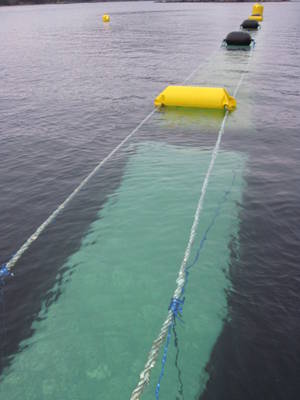 n be weighing them in tons,” say André Wortel and Gerard de Jong from ECN. “The next step is to be able to harvest the seaweed at sea.”
The ECN construction means that seaweed farms can now be started anywhere in the North Sea where the water is between one and three metres deep, from the Norwegian fjords, for example, to the Dutch coast.
Seaweed is currently used on a limited scale for producing chemicals, nutrients and proteins. ECN sees it as an important source of sustainable biomass, which can be used to produce bio-fuels and renewable energy in addition to the more common chemicals, nutrients and proteins. If everything goes according to plan, the seaweed farms will produce enough biomass from the sea to supply a factory for co-producting bio-fuels and high-grade chemicals and nutrients. ECN estimates that if seaweed were to be farmed on less than 10 percent of the Dutch part of the North Sea, it would generate as much energy per year as the total capacity for wind energy on sea and land proposed in the National Energy Agreement.
According to Wortel and De Jong, there are countless other advantages to large-scale seaweed farming at sea. Land will no longer have to be reserved for producing biomass and nutrients, thus diminishing the displacement effect. If farms are placed in the nutrient plumes of rivers, the seaweed will absorb excess nitrogen and phosphates and help combat eutrophication. Salmon and fish farms can also help in this respect. The fish fertilise the seaweed, which can then be used in fish food. Greenpeace and the World Wide Fund for Nature are backing the concept because of these ecological benefits and the broad-based approach to the impact of seaweed cultivation on the maritime ecosystem.
At-Sea is part of an EU innovation programme that will receive funding for various projects over the next seven years.
Source: ECN, October 27, 2015