
Ethiopia’s leap into geothermal power
Categorie(s): News, Sustainable Energy
ADDIS ABABA Oct 24, 2013
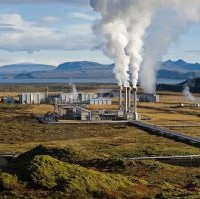
Ethiopia has signed a preliminary agreement with a U.S.-Icelandic firm for a $4 billion investment intended to tap its vast geothermal power resources and help it become a major exporter of energy for East Africa using Icelandic geothermal expertise they willconstruct a 1,000 MW geothermal power plant, Africa’s largest, in the volcanically active Rift Valley.
Ethiopia currently suffers frequent blackouts because of a lack of power. But it is due to boost its generating capacity from 2,000 MW to 10,000 MW within the next three years, much of it coming from the 6,000 MW Grand Renaissance Dam under construction on the Nile.
Experts put its hydropower potential at around 45,000 MW and its geothermal potential at 5,000 MW, but Reykjavik says the accessible geothermal resources could be nearer 15,000 MW.
“For 50 years, everyone has known that there was potential, but the initial risk and initial cost of developing geothermal is high,” said Reykjavik Geothermal managing director Thorleifur Finsson. “After we managed to develop many sites in Asia and America, eyes have been opened that there is a possibility and … today’s technology has minimized that financial risk,” he said. “There is huge potential.”
Power will be extracted from under the volcanic Corbetti Caldera crater by pumping water to a depth of more than 1,000 meters to be superheated in geological strata where the temperature is around 350 degrees Celsius (660 Fahrenheit).
Ethiopia, Africa’s second most populous country, has also been one of the continent’s fastest growing economies, with 9.7 percent growth in fiscal 2012/13.
At the unveiling of the geothermal project in New York Prime Minister Hailemariam Desalegn: “My vision is that over the next 30 years, we will need to harness as much as 80,000 MW of hydro, geothermal, wind and solar power, not just for Ethiopia, but for our neighboring countries as well …
“We will need to partner with the private sector to bring in significant private investment going forward. From that perspective, this 1,000 MW project with RG is not that large – but it’s a great start. What Africa needs now is not just aid, but trade and investment.”
By Aaron Maasho
Source: Reuters