
How to repel insects and pests naturally
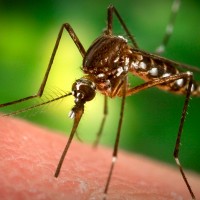
Whether eating our plants, biting our children or just buzzing around our living rooms, insects can be unwelcome visitors. But they are the pollinators, silk producers and recyclers of the Earth, we need insects for our very survival. This is why we should use natural biological controls to repel them and not try to kill one sort and risk killing them all, also the most beneficial.
Kitchen and bedroom
To keep them out of our foodstuffs you can keep everything stored in glass jars with airtight lids. Like all living things, moths and flies need food – no food, no moths. To repel them you can clean cupboards with lavender oil. In order to aid its own survival, lavender (along with some other plants such as eucalyptus, cedar and lemon grass) has evolved to emit smells and substances that moths hate.
To protect bedrooms, you can make your own mothballs. For these cut up an old shirt or sheet, or whatever, into 10cm x 10cm squares, sow them together and fill them with a couple of bay leaves, dried basil leaves, some spearmint, thyme, tansy, rosemary and wormwood. All of these herbs are used to repel moths for the same reason as lavender. This really works, but it can lose some of its potency in time and is therefore best replaced every six months or so. For added protection you can make a hot infusion from some or all of the above herbs. Simply stuff into a teapot, pour on boiling water, allow to cool, strain, decant into a spray gun and spray as required.
Ants, useful but not always
When cooking – in summer – it can happen that, if you left any food around, your kitchen is quickly infested with ants. Also here: no food, no pests. Ants can be pretty stubborn; to deter them you will need other methods. Many ants are not fond of some herbs, including sage, peppermint, tansy, catnip and pennyroyal. Either grow these plants by your kitchen door or make an infusion spray as above. Bicarbonate of soda, coffee grinds, chilli powder or flour are all reported to work if placed around the kitchen door.
Ants play many useful roles in nature, also in your garden, so, let them be where ever they live – if they are not just where you want to sit down… If you find a nest where you want to plant something you can dig up the nest if it is too close. It can be quite interesting watching them pick up their belongings and move house to somewhere else on your plot.
Bye-bye, greenfly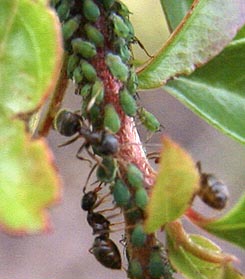
Jam is a great deterrent for greenfly. As obscure as it might sound, a dollop of jam next to your prize beans will stop the ants harvesting the greenfly for their honeydew excreta. Because ants farm greenfly for their sweet tasting excreta, when they taste the jam, so the rationale goes, they say to themselves, ‘that tastes great – better make sure the greenfly don’t eat it’. They then start killing the greenfly to stop it happening, which is nothing short of genius.
Mosquitoes
As our climate gets wetter and warmer we can expect to see numbers of mosquitoes increasing. With more than a million deaths annually attributed to mosquitoes, they can be more than just an irritation in hot countries. In cooler climates they can make your summer less pleasant than expected…
Untidy gardening can attract mosquitoes; if you are not careful your back yard can soon become full of them. Less than 30 ml of water in an open container is enough for as many as 300 eggs. Prevention is better than cure, so ensure you don’t leave out buckets, old plant pots or anything else in which water can collect. Refresh your bird bath regularly so that larvae cannot grow into mosquitoes.
If you’re being troubled by the little blighters then you can repel them with feverfew. Take a few leaves with you and when needed leave them to infuse in hot water, allow to cool then apply to the exposed areas of skin. Crushed garlic blended in water can also be applied but it will pong a little more. One of the most pleasant (but not the most effective) plant-based compounds used for repelling mosquitoes is citronellal, which can be found in lemon balm. To administer, crush a few leaves and rub on to your skin.
You may also notice that you don’t get bitten as much as your friends (or vice versa). This could be down to nutrition . If you don’t get bitten that frequently it may be due to your diet – if you’re bitten a lot then try to improve your diet. High levels of zinc and vitamin B complex can help keep insects away. Many of the vitamin B complex vitamins can be dramatically reduced when drinking alcohol, so some drinks can make you more attractive for them. Therefore, it should be a consideration to supplement your diet if you intend on having a boozy holiday.
Dionaea muscipula, Venus fly-trap >>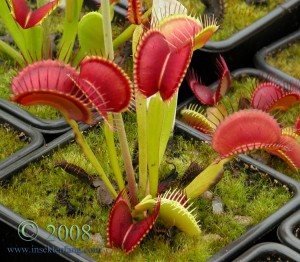
Fruit flies
Fruit flies can collect in groups around your summer fruit. They don’t do any harm, but we do not like them inside. When you have little choice but to collect compost indoors you might come into contact with fruit flies and the smaller compost flies. Once these little pests have set themselves up in your house it is not so much about repelling them as eliminating them. Wetting newspaper and putting it over the top of your compost in the main bin will help to stop them from breeding, but this is not something to do frequently as it will interfere with the composting process. My favourite way of tackling them indoors is with a carnivorous plant, which, as the name suggests, eats the flies.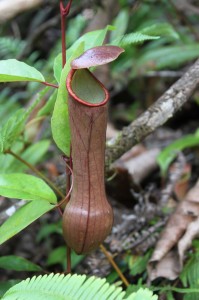
If you do decide to get yourself a carnivorous plant then it needn’t be the freakish-looking Dionaea muscipula, also known as the Venus fly-trap. It could be something far more beautiful such as Nepenthes distillatoria, known as a pitcher plant. These plants can be bought from many specialist florists. They work wonders in keeping the fly population down but can be a little disturbing when you hear a lone fly slowly decomposing while buzzing its final buzz. Not for the fainthearted!
Nepenthes distillatoria, pitcher plant>>
adapted from article by Andy Hamilton in: The Ecologist
Andy Hamilton is co-author of The Selfsufficient-ish Bible: An eco-living guide for the 21st century (Hodder & Stoughton, £30)