
Do Weddell Seals have an Internal GPS?
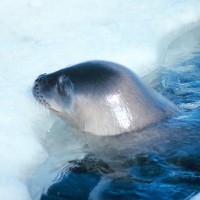
Weddell seals have biological adaptations that allow them to dive deep–as much as of hundreds of meters–while hunting, but also an uncanny ability to find the breathing holes they need on the surface of the ice. Now, researchers supported by the National Science Foundation (NSF) believe they have figured out how they do it — by using the Earth’s magnetic field as a natural GPS.
“This animal, we think, may be highly evolved with an ability to navigate using magnetic sense in order to find ice holes some distance apart and get back to them safely,” explained Randall Davis of the Department of Marine Biology at Texas A&M University.
If the hypothesis turns out to be true, it would represent the first evidence of such a trait in a marine mammal.
The question of how seals navigate is more than academic. It’s about life and death for the animals, which like all mammals, require oxygen to breathe, despite their mostly aquatic environment. Time spent looking for a new place to surface after each dive would not only be inefficient given the energy required to swim and hunt, but failure to locate a hole in the ice means the animal would drown.
“These animals are doing a remarkable amount of exercise all while on breath hold,” noted Terrie Williams, a professor of ecology and evolutionary biology at the University of California, Santa Cruz. She is an expert on physiology in the Weddell seal, an animal whose apparent lethargy on the surface of the sea ice belies an amazing athleticism below it.
“The reason a seal wants to be efficient is that they have a limited amount of oxygen onboard,” she explained. “The trick is conserving that ‘scuba tank’ on a dive.”
The idea that Weddell seals can and unerringly follow magnetic lines dates back to the late 1990s . Fuiman said he was struck by data from the very beginning that showed the seals returning to dive holes with amazing precision.
From: Allison Winter, ENN
June 6, 2013