
Cedar Trees Beneficial Uses
Categorie(s): Ecology, News, Trees
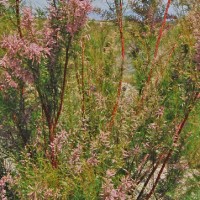
Deserts are an unlikely place to find a form of plant life that is so promising as to grow quickly on very little. Still, arid climate plants are very hardy. Tel Aviv University researchers are doing their part to reduce humanity’s carbon footprint by successfully growing forests in the most unlikely place — deep in Israel’s Aravah Desert. With environmental ‘extras’ such as a local plant species, recycled sewage water unsuitable for agriculture, and arid lands unusable for crops, a group of researchers including Profs. Amram Eshel and Aviah Zilberstein (TAU’s Department of Molecular Biology and Ecology of Plants at the George S. Wise Faculty of Life Sciences and the university’s new Renewable Energy Center) have discovered a winning combination.
In many parts of the world, including areas of India, central Asia and the Sahara desert where the climate is arid and the landscape barren, these standing crops can soak up carbon dioxide from the atmosphere and convert it into oxygen.
“Though maintaining our current forests is a necessary initiative,” Prof. Eshel says, “it is not enough to off-set human carbon output. In their quest to create forests that diminish carbon dioxide in the atmosphere, many countries have been converting fertile agricultural lands into forests. But we believed that encouraging growth on a piece of land that was traditionally barren, such as desert land, was a step in a better direction.”
To conserve fresh water, the researchers used relatively poor quality water considered, such as recycled sewage water and salt water that was the by-product of inland desalination plants. The final piece of the puzzle was to find a plant hearty enough to successfully grow in the desert. The researchers turned to Tamarix, a botanical genus that includes salt cedar trees and is indigenous to the old-world deserts. Some 150 different varieties of the botanical genus were used, grown in both a common garden setting and in densities that mimicked commercial crops.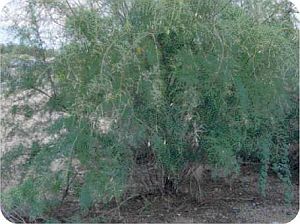
The genus Tamarix (tamarisk, salt cedar) is composed of about 50-60 species of flowering plants in the family Tamaricaceae, native to drier areas of Eurasia and Africa. They are evergreen or deciduous shrubs or trees growing to 1—18 m in height and forming dense thickets. The largest, Tamarix aphylla, is an evergreen tree that can grow to 18 m tall. They usually grow on saline soils, tolerating up to 15,000 ppm soluble salt and can also tolerate alkali conditions.
Tamarisks are characterized by slender branches and grey-green foliage. The bark of young branches is smooth and reddish-brown. As the plants age, the bark becomes bluish-purple, ridged and furrowed. The leaves are scale-like, 1—2 mm long, and overlap each other along the stem. They are often encrusted with salt secretions. The pink to white flowers appear in dense masses on 5—10 cm long spikes at branch tips from March to September, though some species tend to flower during the winter.
With the first harvest of trees just last summer, researchers have much to process, including analyzing the amount of carbon dioxide the crops have successfully captured from the atmosphere. The answers will determine how much carbon such a crop can offset.
The cut trees themselves might also be used as a source of renewable energy. These biomass or biofuel crops, derived from natural crops, could help to reduce dependence on traditional fossil fuels such as coal. But the question of where to grow crops dedicated to fuel production had to be addressed, since converting agricultural land could have the side effect of creating food shortages.
“Arid and previously unused desert lands provide an ideal solution,” Prof. Eshel says. To make his approach economically feasible, much more land would be needed than Israel can provide. But similar tracts of land, such as the Sahara Desert, are big enough to grow these types of crops on a larger scale. He adds that what has been done in the Israeli desert can be replicated elsewhere to great effect.
For further information:
www.aftau.org/site/News2?page=NewsArticle&id=15427
N.B.
Tamarisk Salt Cedars can be a risk in other regions!
They absorb large amounts of water and create large deposits of salt.
They are native to drier areas of Eurasia and Africa – in the America’s they can be very harmful invasive plants.
Salt cedars were introduced into North America in the early 1800s as an ornamental. But since that time, they have wreaked untold havoc on North American waterways
A mature saltcedar plant can produce 600,000 seeds annually, and can flower during its first year. Seeds are easily dispersed by wind and water, and severed stems and shoots of saltcedar readily root in moist soil.
Riparian ecosystems have been detrimentally affected by saltcedar and other factors. The monotypic stands of saltcedar aggressively replace willows, cottonwoods, seepwillow/baccharis and other native riparian vegetation. Native Southern California vegetation is usually replaced by salt cedar after a fire, established on burned sites through off-site seed sources.
In its native habitat, Salt Cedar is kept in check by several species including a leaf beetle (Diorhabda elongat) and manna scale (Trabutina mannipara). In its native range, 115 insect species and four mites are known to attack saltcedar. By feeding on the saltcedar, the biocontrol insects could have a great impact on population growth. These species are naturally absent in California.
Do not plant Tamarix, Salt Cedar in California!