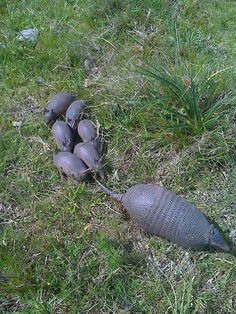
Armored giant turns out to be vital ecosystem engineer

The giant armadillo (Priodontes maximus) is not called a giant for nothing: it weighs as much as a large dog and grows longer than the world’s biggest tortoise. However, despite its gigantism, many people in its range—from the Amazon to the Pantanal—don’t even know it exists or believe it to be more mythology than reality. This is a rare megafauna that has long eluded not only scientific study, but even basic human attention.
However, undertaking the world’s first long-term study of giant armadillos has allowed intrepid biologist, Arnaud Desbiez, to uncover a wealth of new information about these cryptic creatures. Not only has Desbiez documented giant armadillo reproduction for the first time, but has also discovered that these gentle giants create vital habitats for a variety of other species.
“Giant armadillos provide a very valuable ecosystem service to the rest of the ecological community: a shelter form predators and temperature extremes as well as new feeding resources,” Desbiez with the Royal Zoological Society of London and head of The Pantanal Giant Armadillo Project told mongabay.com.
A great digger
The shelter he’s referring to is the giant armadillo’s deep burrows, which the busy beasts dig every other day on average. Using claws that any velocirpator would envy—including one that runs up to 17 centimeters (over 6 inches) long—giant armadillos dig out burrows over five meters (16 feet) deep. The armadillos use these burrows for sleeping, resting, and even foraging, since they primarily feed on termites and other invertebrates.
Ecosystem engineer
But the burrows have other users too. Employing remote camera traps at 70 different burrows in the Brazilian Pantanal, Desbiez and his team recorded over two dozen species crashing giant armadillo homes for different purposes, from keeping cool to hunting. This makes the giant armadillo an “ecosystem engineer,” i.e. a key species that drastically alters or re-creates its environment, impacting many other species. Well-known ecosystem engineers include beavers, elephants, and, of course, ourselves: humans are the ultimate ecosystem engineer.
According to Desbiez’s new study in Biotropica, ocelots, crab-eating fox, various lizards, tortoises, and the weasel-like tayra were all discovered using the insides of the deep burrow as a refuge. But it wasn’t just the inside of the burrow that species employed. Many species utilized the sand mound created by extensive digging: peccaries, giant anteaters, tapirs, and pumas all used the sand mound for resting or sand-bathing, while various birds, rodents and lizards hunted insects in the sand mound. In addition, the three other armadillo species (southern naked tail, nine banded, and six banded) found in the Pantanal also used the burrows.
Is a Baby Giant Armadillo Cute? Yes!
Despite weighing as much as full-grown human, almost nothing is known about the giant armadillo including its breeding and reproductive behaviors. How does mating occur? How long does pregnancy last? How many babes are typically born? Scientists are simply in the dark, but a ground-breaking study employing camera traps is beginning to change this. For the first time, scientists in the Brazilian Pantanal have documented giant armadillo breeding and the happy outcome: a baby giant armadillo (see photo below).
Following a female giant armadillo with remote camera traps, the project began noticing a male in photos in January of last year. Romance bloomed much as it does with humans, with the lovesick male even visiting some of the female’s unoccupied burrows. Six months later, the male and female moved in together. They stayed together for a few days until the male disappeared. Some months later the female appeared with her young.
Source: Jeremy Hance,
in MONGABAY.COM February 20, 2013