
Smaller Fish – The Decade’s Most Underreported Story?
Categorie(s): Ecology, Food for Mankind, News
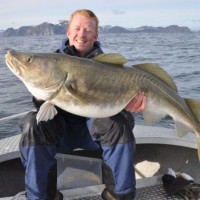
What was the underreported environmental story of the decade?
In 2000, Nobel Prize winner Paul Crutzen coined the term “Anthropocene” (anthropos = human being) for the current epoch in recognition of humans as a dominant force for environmental change on the planet. In the past decade’s intervening years we saw a lot of new science on the environment, much of which documented the growing influence we humans are having on the globe.
One indication that we’re now in the Anthropocene is the rapid decline in biodiversity; humanity is causing major and irreversible changes in our planet’s genetic makeup by destroying habitat and literally wiping species off the face of the Earth. That was news, important news, but it was hardly underreported.
But what about a more subtle change, like causing the fish of the ocean to literally evolve before our very eyes? That’s the decade’s most underreported environmental story.
We usually think of evolution as a slow, orderly process occurring over millennia, on what we call geologic time scales. But genetic changes in a population can occur much more rapidly. The influenza virus is a great example. So is the development of antibiotic resistant bacteria. And the evolution of fish now appears to be another.
Fisheries-Induced Evolution
Natural selection typically drives evolution by weeding out the weak and old and leaving the fittest to survive and pass on their genetic makeup to the next generation. But it doesn’t have to work that way. Imagine a situation where a species is suddenly confronted with a new a predator, a predator that wipes out maybe 50% of its population each year (a predation rate many times larger than the population had evolved under) and does so in a very selective way — by taking the largest of the species. Under that type of selection pressure, population biologists tell us that the genetic makeup of the species will quickly evolve one that favors more rapid maturation and smaller size at maturation.
Theory tells us it works like this:
-
Size-selective fisheries remove a large percentage of fish that are above a certain size and typically mature enough to have produced offspring.
-
With their loss, reproduction of the population favors individuals that invest energy in maturing faster and reproducing earlier in life rather than in growing larger.
-
The result: over the course of just a few generations we have a population of smaller individuals that mature and reproduce more rapidly.
It turns out we have been busy unwittingly carrying out our own little experiment to see if the theory really works. It’s called fisheries-induced evolution. By fishing for the largest fish and overfishing, we appear to have single-handedly engineered a rapid genetic change in the ocean’s fish — a change characterized by declining age and size of fish at maturity.
Fish Getting Smaller: A 20th Century Theory Manifest in the 21st Century
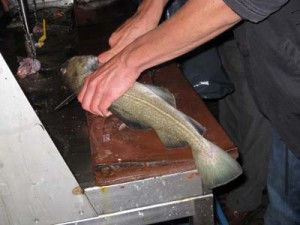
The concept of fisheries-induced evolution is not a new idea. Dr. Mikko Heino (University of Bergen, Norway) puts it like this:
“The first suggestion that fishing may drive evolution is more than a century old, and there has been sporadic interest ever since. Interest started to increase in late 1980s, but the real wake-up happened after year 2000. Several things fell into place around that time: methods to analyze data from wild fish stocks were improved and started to suggest that evolutionary changes are commonplace, fast evolution was demonstrated in tank experiments, and more realistic models were developed. This happened against the background of growing recognition among academics that contemporary evolution is commonplace.”
The signs of fisheries-induced evolution are striking. For example, scientists have found that changes in maturation traits (age and size) correlate significantly with fishing intensity; the most heavily exploited stocks experienced the largest declines. Such evidence supports the idea that fishing is driving evolutionary change as these changes should be most apparent in the most heavily exploited stocks.
Most of the genetic evidence showing that selection practices epitomized by fishing can lead to rapid genetic changes comes from laboratory experiments that isolate heritable traits while controlling for other variables that would be in play in natural environments. This work shows that traits can evolve with fishing pressure. To date there has been only one study that linked molecular changes in wild fish to fishing pressure.
What’s Next in the Evolutionary Line?
Evidence of human-induced evolution of fish occurring on small timescales is big news for geneticists, population biologists, and environmental scientists. It’s all relevant to fishers and those of us who like to eat fish. And given the amount of attention it has gotten (not much), it rates right up there as one of the most underreported environmental stories of the past decade.
So what’s the next scientific challenge? Here’s an idea; how about doing another human-induced evolutionary experiment to be sure we’ve got it right. What about changing fishing habits (e.g., adding marine reserves, limiting fish catches, fishing sustainably) to see if we can reverse the process and re-establish a fish genome that is more like what we had before. Is that possible? Well, some recent research suggests that at best recovery rates will be quite slow. But science is fun and the world can do some surprising things. Let’s do the experiment and see what happens.
by Bill Chameides , January 12th, 2010
inTHEGREENGROK