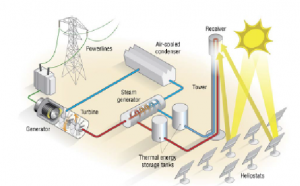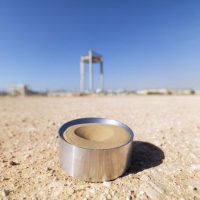
Unlike traditional storage media used in thermal energy storage systems, such as synthetic oils and molten salts, sand is abundant in regions with plenty of sunshine, and inexpensive to obtain.
“The hourglass idea inspired the system, as it uses two reservoirs connected to one  another vertically across a narrow passage that allows the movement of ‘cold’ grains of sand from the upper reservoir to the lower ‘hot’ one.”
The sand is heated by running cold sand through a solar heat collector, where it is heated before being stored in a hot reservoir. This hot sand can be used to run electricity-generating turbines. The cycle is completed by returning the cooler sand to the upper cold sand reservoir.
There have been several experiments around this technology in Europe and the United States. However until now, they did not render any results that can be made available or capitalised . There are challenges facing those experiments, the most important of which are the cost and the method used to recover energy. Stored energy recovery processes require the presence of a fluid, either a liquid, air, or gas that is injected into the turbine. This process consumes a lot of energy, which raises the costs.
More research and funding is needed to commercialise the technology. “Securing funding poses a challenge as we need nearly US$300,000 to test the system in the pre-marketing stage,” Calvet adds.