
The best plants to clean your air
Categorie(s): City life, Health

Do you like to have some nature inside your home with nice plants? It not only looks nice, plants inside, the home (and the office!) but it is also proven to be healthy! Nasa did research about the species that are best in cleaning the air – and easy to keep.
NASA Clean Air Study
In the ’80’s NASA studied together with Associated Contractors of America (ALCA) the air cleaning effects of several indoor plants. This was of course meant to see if it was a way to clean the air in space stations. The NASA Clean Air Study lead by dr. Wolterton showed that quite a lot of indoor plants are able to remove harmful substances like formaldehyde, benzene ammonia from the air.
Sick from unhealthy inside air
Many modern materials used in building, cleaning and upholstery ‘breath out’ these toxic chemicals and pollute our inside climate. For instance formaldehyde comes from curtains, floorcovering and plasterboard. Because buildings are nowadays better insulated and less ventilated these volatile chemicals stay in our rooms longer. The result is that our inside air is 5 to 10 times more polluted than outside air. This can result in dry eyes, tiredness, head ache and allergic reactions: the sick building syndrome
The best and easiest indoor plants
Dr. Wolverton made a list of the 50 best and easiest air cleaning plants in the book How to Grow Fresh Air. The absolute number 1 is the yellow butterfly palm (Chrysalidocarpus lutescens). It removes all air polluters indoors. Peace lily (Spathiphyllum ‘Mauna Loa’) with elegant white flowers (photo) looking like a spoon is also a champion air cleaner. Both dragon trees or Dracaena’s in NASA’s study (Dracaena marginata en Dracaena fragrans) can do good work too. These sturdy plants are perfect for those without green fingers: they can live in sunhine or shadow and do not need frequent watering. They remove formaldehyde, benzene and trichlooretylene. Dracaena marginata removes also xylene and toluene from the air.
The best:
- English ivy (Hedera helix)
- Peace lily (Spathiphyllum ‘Mauna Loa’)
- Chinese evergreen (Aglaonema modestum)
- Bamboo palm (Chamaedorea seifrizii)
- Red-edged dracaena, marginata (Dracaena marginata)
- Cornstalk dracaena, mass cane/corn cane (Dracaena fragrans ‘Massangeana’)
- Weeping fig (Ficus benjamina)[4]
- Barberton daisy, gerbera daisy (Gerbera jamesonii)
- Florist’s chrysanthemum, pot mum (Chrysanthemum morifolium)
- Dracaena deremensis “Janet Craig”)
- Warneckei (Dracaena deremensis “Warneckei”)
- Mother-in-law’s tongue (Sansevieria laurentii)
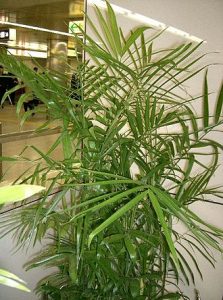
Bamboo palm (Chamaedorea seifrizii)