
Algae Farm Power
Categorie(s): Agriculture, Biotechnology, News, Sustainable Energy, Sustainable projects, Waste
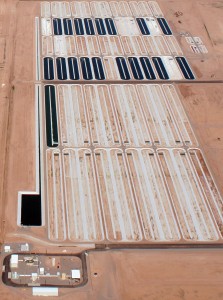
Algae fuel or Algal biofuel is an alternative to fossil fuel that uses algae as its source. Harvested algae, like fossil fuel, release CO2 when burnt but unlike fossil fuel the CO2 is taken out of the atmosphere by the next generation of growing algae. Columbus, New Mexico is a pretty good place to stage the first attempt to cultivate crude oil as an agricultural crop. To do so, three partners are attempting to do something that has never been achieved before — using algae as a major, global crop platform — not on the scale that has produced vitamin and nutritional supplements, but on the scale and at the costs more like the great staple crops around the world. They are turning a 300-acre expanse of desert scrub into the world’s largest algae farm designed to produce crude oil.
“We take algae, CO2, water and sunlight, and then we refine it,” says Cynthia Warner, the chief executive of Sapphire, who joined the company after working for more than 20 years at oil-company giants Amoco and BP. “Algae”, she says, “have the potential to change the world, by reducing carbon dioxide emissions and enabling almost any country to make its own oil. This technology is so compelling and it will make such a big difference that it will change the world.”
Other algae farms are under development in Hawaij, in Karratha, Australia, and in Florida. In Europe, the Swedish energy company Vattenfall and Italy’s Enel Group have been using algae, for producing fuel or food, to absorb greenhouse gas emissions from power plants.
Wet farming
An algae farm needs flattish land preferably with a slight grade because you have to move the water . That way, you get gravity assisting in flowing water downhill. When it reaches the bottom of the farm, it can be pumped back to the top with energy-efficient pump technology. Like rice, the field is flooded.
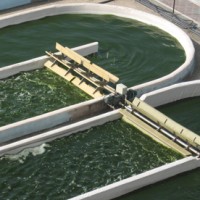
Such algae farms would be based on the use of open, shallow ponds in which some source of waste CO2 could be efficiently bubbled into the water and captured by the algae. The ponds are “raceway” designs, in which the algae, water and nutrients circulate around a racetrack. Paddlewheels provide the flow. The algae are thus kept suspended in water. Algae are circulated back up to the surface on a regular frequency. The ponds are kept shallow to keep the algae exposed to sunlight. The ponds are operated continuously; that is, water and nutrients are constantly fed to the pond, while algae-containing water is removed at the other end.
The harvest
There are several technical factors to consider. Dry mass factor is the percentage of dry biomass in relation to the fresh biomass, e.g. if the dry mass factor is 5%, one would need 20 kg of wet algae to get 1 kg of dry algae cells. Lipid content is the percentage of oil in relation to the dry biomass needed to get it, i.e. if the algae lipid content is 40%, one would need 2.5 kg of dry algae to get 1 kg of oil.
Using waste
Algae require nutrients, sunlight & water to grow.They thrive on saline, brackish and waste waters. There have been proposals made where wastewater, human waste, animal waste & plant waste, along with C02 emissions from industrial processes can all be used as the nutrients in algaculture. After oil is extracted from the algae the residue is then used as an animal feedstock or as a soil fertilizer.
Algae are more efficient users of solar energy
Microalgae are the most primitive form of plants. While the mechanism of photosynthesis in microalgae is similar to that of higher plants, they are generally more efficient converters of solar energy because of their simple cellular structure. In addition, because the cells grow in aqueous suspension, they have more efficient access to water, CO2, and other nutrients. For these reasons, microalgae are capable of producing 30 times the amount oil per unit area of land, compared to terrestrial oilseed crops
GM-algae?
Synthetic Genomics is going a step further, studying natural algae in order to design, from scratch, a plant of its own. Venter, the company founder, told Scientific American last year: “Everybody is looking for naturally occurring algae that are going to be miracle cells to save the world and, after a century of looking, people still haven’t found them. We hope we’re different.” Venter noted that genetic tools “give us a new approach: being able to rewrite the genetic code and get cells to do what we want them to do.”
It is the future
So Algae Power is not yet here but the mechanics of successful production is being studied and tested.
Adapted from: Andy Soos, ENN, October 17, 2012